
 The American Revolution on Long Island
by
The American Revolution on Long Island
by
 Chronicles of the British occupation of Long Island
by
Chronicles of the British occupation of Long Island
by
 Indexes to Onderdonk's Revolutionary Incidents of Long Island, N.Y.
by
Indexes to Onderdonk's Revolutionary Incidents of Long Island, N.Y.
by
 Long Island In The American Revolution
by
Long Island In The American Revolution
by
 George Washington's 1790 Grand Tour of Long Island
by
George Washington's 1790 Grand Tour of Long Island
by
 Lost British Forts of Long Island
by
Lost British Forts of Long Island
by
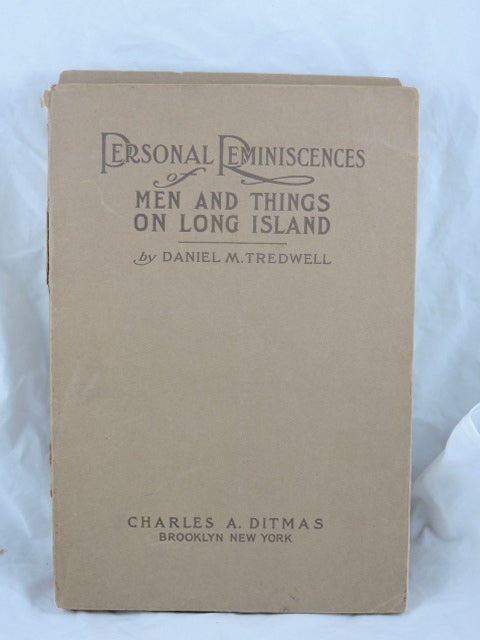 Personal Reminiscences of Men and Things on Long Island
by
Personal Reminiscences of Men and Things on Long Island
by
[Volume One, page, 34]
Jerusalem was settled by Captain John Seaman, of Danish origin. He had six sons and six daughters. They came from Stamford in 1666, although John Seaman's deed for 6,000 acres at Jerusalem bears the date 1657. It was witnessed by Wantagh, Sachem. There are now thousands of the descendants of Captain John Seaman in the United States, and they fill honorable positions. They are senators, congressmen, lawyers, judges, doctors and generals, and they are still in evidence in Jerusalem; every other family is a Seaman. During the Revolution it is said that the Seaman family, when the place was looted by one of the contending armies, had the silver saved by one of their slaves throwing it into the swill-barrel. Tradition says that a village community of Indians were settled in the immediate neighborhood when the white man arrived and claimed tribal jurisdiction over all the territory from Old Westbury to Jerusalem South.
[Volume One, page 167]
The Sammis Tavern is located on the North Side of the Turnpike Road extending through Long Island, east and west, and is located in the Village of Hempstead. It was built by Nehemiah Sammis in 1680, and is probably one of the oldest, if not the oldest inn in the United States. It has consequently been standing about 200 years continuously in the Sammis family. The grandfather and father of the present owner were born on the premises. The inn was used by the British officers as their headquarters during the Revolution. The people of Hempstead were generally loyal to England and were treated by the British with great consideration. The farmers were paid for their produce in British gold. After the Revolution Washington visited this old inn and testified his satisfaction of the accommodations and hospitality of the home. This was in 1788 when Washington was on his way to New York City to attend the Federal celebration. He came across the Sound, landing at Lloyd's Neck and drove across the plains accompanied by a body guard of fifty young men of Oyster Bay.
[Volume Two, 232]
Among the many stories of Revolutionary times in circulation along the south shore when I was a boy and when loyalists were remembered with bitter resentment, one occurs to me which seems quite in place on the present occasion because it transpired in this immediate locality in 1780, the facts of which are that the British packet ship 'Carteret' with a valuable cargo of goods, also specie and important public papers from the home government in England to the Colonial government at New York, was pursued by an American privateer and driven on shore right over yonder in sight of this spot at Jones' Beach.
Tradition says that by the assistance and procurement of the South Hempstead Tories the officers and crew of the 'Carteret' were enabled to escape to New York with the papers, specie and other valuables and an empty prize was left for the captors. By the information carried to New York, a British fleet was immediately dispatched in pursuit of the privateer to escape which the privateer was obliged to hurry away under full sail. The 'Carteret' was in consequence left to the mercy of the waves and the king's loyal subjects of the south shore, who completely looted and dismantled her. She was sold by the Town of Hempstead at auction as she lay on the beach for £100.
[Page 26]
Joseph Smith (1754-1844), of the f if th gene ration, was twentytwo years of age when the Declaration of Independence was signed on July 4, 1776.
Numerous inquiries have been made as to whether there is any¬ thing in the old papers relative to parts taken by some of our an¬ cestors in the war of the American Revolution. There is nothing. The inhabitants of Long Island were in a most difficult position all through the war. They lacked opportunity for expression or for centralization of purpose; they did not, nor could they, take an ag¬ gressive part against the British. The Battle of Long Island was fought and lost August 27, 1776, less than sixty days after the
signing of the Declaration of Independence, and from then on through¬ out the war Long Island was in possession of the British. Their vessels were in New York harbor to the west, in the harbors and bays along the north side of the Island, and in Gardiner's Bay to the east. The presence of an invading army and the constant sur¬ veillance they exercised was irksome to those peace-loving farmers, but since cattle and farm products were at the call of the British soldiery anyway there was little object in resistance, and the far¬ mers' supplies seem not to have been drawn upon to the point of des¬ titution.
Quite a number of the inhabitants of the easterly part of Long Island gathered together what they could and were conveyed in boats across the Sound to the shore of Connecticut. This gave some an opportunity to enlist in the Continental cause but many of them and their families became public charges and their lot was worse than that of those who remained. There were bitter encounters at times in some of the towns at the head of harbors or bays on the north side, and there is a legend, which seems to have had its au¬ thenticity recognized, according to which there was an encounter in Swift Creek, inside of Jones or New Inlet, south of Merrick,